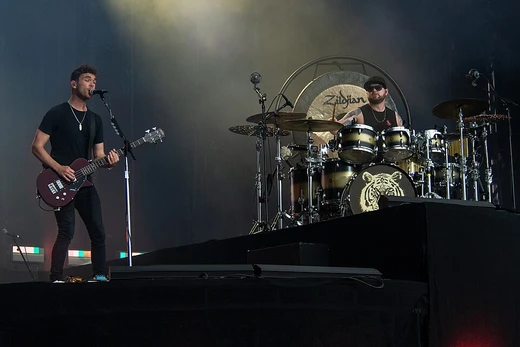
Chas & Dave
English duo who created the rockney style blending cockney and rock.

Wikipedia / Wikimedia Commons
Chas & Dave (also known as Chas 'n' Dave) were an English pop rock duo from London, made up of Chas Hodges and Dave Peacock. They created a style called rockney—a blend of rock and cockney—that combined pub singalongs, music-hall comedy, boogie-woogie piano, and pre-Beatles rock 'n' roll. Their own record label was also called Rockney for a while. Their big break came in 1979 with "Gertcha," which reached No. 20 on the UK Singles Chart and was the first of eight Top 40 singles they played on. Their biggest hits came in the early 1980s: "Rabbit" and "Ain't No Pleasing You." They also had nine albums that charted. In October 2013, they released *That's What Happens*, their first studio album in 18 years.
Hodges and Peacock first met in 1963, but didn't start writing songs together until 1972. During the 1960s and 1970s, both played in various bands. Hodges was in The Outlaws and later Cliff Bennett and the Rebel Rousers. Peacock was in a group called the Rolling Stones (formed before the famous one), The Tumbleweeds, and worked with Mick Greenwood and Jerry Donahue. They both played in Black Claw with Harvey Hinsley and Mick Burt; three of them—Hodges, Peacock, and Burt—later formed Chas & Dave. They recorded with Albert Lee and released an EP called *Country Pie*. After Black Claw, Hodges joined Heads Hands & Feet in 1970. Both men worked as session musicians and backing band members for many artists. Hodges, with The Outlaws, worked with Jerry Lee Lewis, Gene Vincent, and Bill Haley, and as the Rebel Rousers they supported the Beatles. In 1975, Hodges and Peacock played guitar and bass on Labi Siffre's "I Got The...", whose hook was later sampled for Eminem's "My Name Is."
While touring America with Heads Hands & Feet, Hodges got the idea to perform in his natural accent, feeling it was "not quite real" to sing in an American accent for an American audience. After Heads Hands & Feet split in November 1972, Hodges suggested to Peacock they form a band where they could sing in their own accent about things they knew. That was the start of Chas & Dave. They considered names like Chubby, but settled on Chas & Dave after a producer kept referring to them as one and said, "Here comes Chas and Dave," then suggested they just use that name. They also recorded as Oily Rags (cockney rhyming slang for cigarettes) and released a self-titled album with Gerry Hogan and
- field
- Pop rock duo
- nationality
- English
- known_for
- Rockney musical style, eight Top 40 UK singles, nine charting albums
- formed
- London
- years_active
- 1972–2009, 2011–2013
Lore & Background
Charles Nicholas 'Chas' Hodges and David Victor 'Dave' Peacock met in 1963, but the duo only started writing songs together in 1972. In the 1960s and 1970s, Hodges and Peacock were in various groups. Hodges was with The Outlaws and then Cliff Bennett and the Rebel Rousers in the 1960s, while Dave Peacock was with a group called the Rolling Stones (formed before the more famous one), and The Tumbleweeds, and worked with Mick Greenwood and Jerry Donahue. Hodges and Peacock were both part of Black Claw with Harvey Hinsley and Mick Burt; three of them (Hodges, Peacock and Burt) would later be in Chas & Dave. They recorded with Albert Lee, and released an EP called Country Pie. After Black Claw, Hodges joined Heads Hands & Feet in 1970. Both Hodges and Peacock had worked as session musicians and in backing bands for a wide range of artists; Hodges as part of The Outlaws had worked with Jerry Lee Lewis, Gene Vincent, Bill Haley, and also supported the Beatles as the Rebel Rousers. The hook of the song on which Hodges and Peacock played guitar and bass in 1975, Labi Siffre's 'I Got The...', was later sampled on Eminem's 'My Name Is'.
Hodges toured America when he was with Heads Hands & Feet, and it was during the tour that he had the idea of performing in his natural accent as he thought it 'not quite real' performing in an American accent to an American audience. After Heads Hands & Feet broke up, in November 1972, Hodges spoke to Peacock about forming a band together where they can sing in their own accent and about things they knew. This would be the beginning of Chas & Dave. They had initially considered a few names, including Chubby. The name Chas & Dave came about when they were doing sessions together, and a producer often referred to them as one and said, 'Here comes Chas and Dave', and later suggested: 'Why don't you just call yourselves Chas and Dave?' They also recorded as Oily Rags (cockney rhyming slang for cigarettes - 'fags'), and released a self-titled album with Gerry Hogan and Ian Wallace in 1974, as well as an album with Oliver Nelson. The album Oily Rags was released by Signature Records owned by Bob Thiele, whose wife Teresa Brewer recorded the first ever song written by Hodges and Peacock together, 'Better Get Your Shoes On'.
Reader's Guide
Chas & Dave are significant for pioneering the rockney style, which brought cockney vernacular and music-hall traditions into pop rock, achieving commercial success in the late 1970s and early 1980s. Their breakthrough came with 'Gertcha' in 1979, followed by top 10 hits 'Rabbit' and 'Ain't No Pleasing You'. They also had a notable association with Tottenham Hotspur Football Club, writing several FA Cup final songs. Their influence extended beyond their own recordings: their instrumental work on Labi Siffre's 'I Got The...' was later sampled by Eminem. After a hiatus, they reunited for tours and released their first studio album in 18 years, 'That's What Happens', in October 2013. Their legacy includes a BBC Four documentary and continued recognition for their distinctive, authentic sound.
Did You Know?
- The duo's name came from a producer who referred to them as 'Chas and Dave' during sessions.
- They turned down recording the theme for 'Only Fools and Horses' because they were in Australia.
- Their song 'Snooker Loopy' reached number six on the UK Singles Chart in May 1986.
- They opened for Led Zeppelin at the 1979 Knebworth Festival on two consecutive Saturdays.
More in English rock music duos 1-24
Spotted an error? Know more?
This is a living reference — every entry is fact-audited, and reader corrections feed straight into our audit queue. Suggest an edit · See this site's audit record